
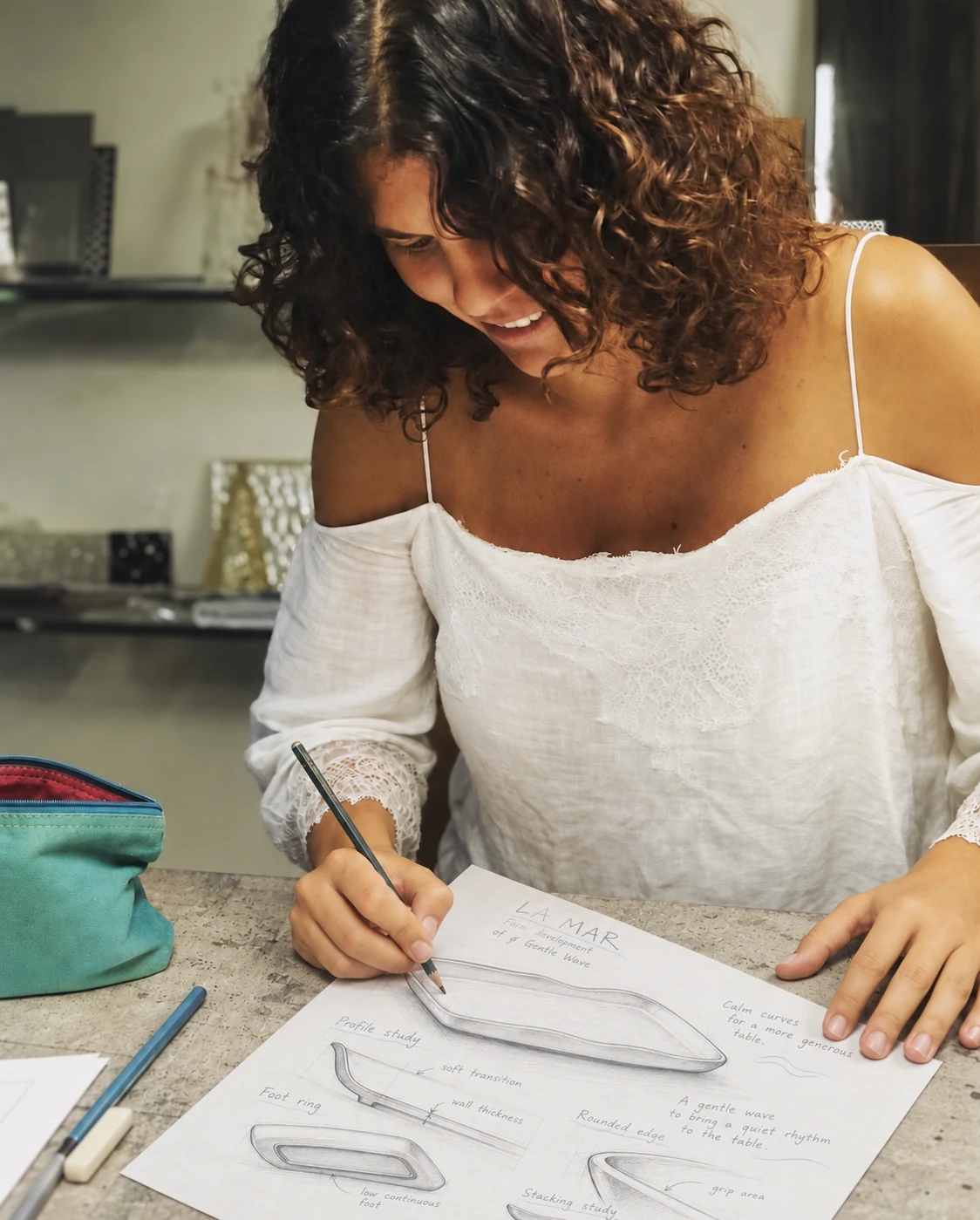
I like the moment when an idea is still on paper. Nothing is quite settled. The curve can move, the edge can soften, and the piece can become something slightly unexpected.
But even then, I am imagining it in use. Someone reaching across a restaurant table. A waiter setting it down. The food arriving and changing the whole composition.
That is where designing tableware becomes interesting to me: the conversation between an object and everything happening around it.
Finding the line
A collection can begin with something small. A colour, a fragment of pattern, the movement of water. The first sketches explore what that starting point might become.
A wave, for example, could appear as decoration. Or it could influence the outline of a platter: a gentle change in its edge, with no illustration needed.
Those choices create different moods. A regular outline can give a composition a sense of order. A softer, less expected shape can introduce movement. Neither works on its own; it depends on the food, the other pieces and the setting.
Giving the idea its proportions
Drawing the piece from above is only part of the work. Seen from the side, it raises new questions.
How high should the rim be? How does the base meet the table? Is there enough space to lift it comfortably?
A technical drawing gives those questions dimensions. A three-dimensional study helps us explore the volume and see how the different views belong to the same object.
There is often some back and forth here. A line that feels right in a sketch may need adjusting once it has depth.
Leaving room for the material
Then the material joins the conversation.
A glaze catches on an edge. A curved surface changes how a drawing reads. A finish that looks quiet on screen may become much more expressive under restaurant lighting.
This is why a render is a proposal, rather than proof of a finished product. Physical samples are where weight, colour, balance and touch can be assessed—and where the design may need another adjustment.
Thinking beyond one piece
I also want to know what sits beside it.
A sculptural bowl might need a simple plate. A patterned platter might feel at home beside plain linen and understated glassware. Giving one piece room to stand out can make the whole table feel more considered.
At Genuine & Unique, bespoke tableware development connects this creative work with sourcing, sampling, production and procurement through to delivery.
The pleasure is in following an idea far enough that someone can eventually pick it up, use it and make it part of their evening.