
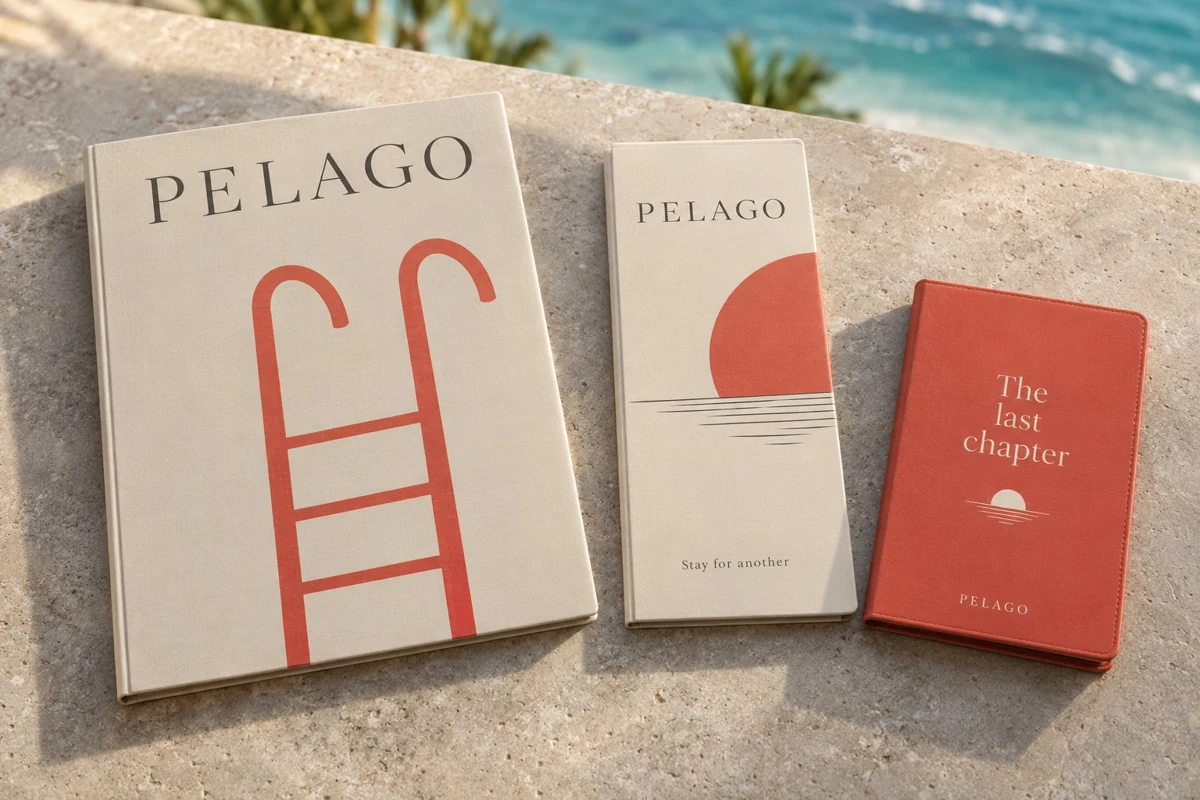
You sit down. Look around. Someone hands you the menu.
You haven’t ordered anything yet, but you already have a small piece of the restaurant in your hands. Its texture, its weight, the colour and the way it opens begin to tell you where you are.
And there’s a lot to design right there.
When we think about a restaurant, it’s easy to picture the lighting, the chairs, the tableware or that bar where you feel like staying a little longer. The menu deserves a place in that conversation too. It sits on the table, gets picked up, opened and shared. It accompanies one of the most enjoyable parts of eating out: deciding what to order and negotiating what you’re going to try from everyone else’s plates.
I’m currently developing a collection of menus, drinks menus and check presenters for a restaurant whose decoration I helped create. It’s especially lovely to return to the project on a different scale: from the space itself to the objects guests will hold in their hands.
Having been involved in the decoration gives me a very personal starting point. I know the place and the decisions that helped give it character. Now it’s about bringing that same sensibility to small pieces that people will look at closely and use every day.
It’s one of the things I enjoy most about my work: being able to keep developing a project through its details.
But translating the personality of a space into a menu has its own logic. You have to decide what to draw from the atmosphere. Perhaps a colour, a texture or a line that appears in the décor. Sometimes a single well-chosen detail is enough to make the piece feel completely at home.
There’s room to introduce something new, too. An unexpected inside cover, a combination of materials, a little contrast. The menu can have a personality of its own while still speaking the same language as the restaurant.
Then comes the practical side, which has plenty to do with design as well.
How does it open? How much does it weigh? Does it fit comfortably between the plates and glasses? Can you read it under the dinner lighting? What happens when a dish changes or a page needs replacing?
These questions shape the format, construction and materials from the start. A menu that’s awkward to handle creates extra work for guests and staff alike. A thoughtful solution makes something as everyday as changing a page feel easy.
And then there’s real life: hands, stains, cleaning, moving from one table to the next. You can fall in love with a finish on a sample. You also have to imagine it on a Saturday night.
That’s why I like to think of these pieces as a small collection, each with its own role.
The main menu needs space and a clear structure. The drinks menu can be narrower, lighter and stay on the table while the conversation continues. The check presenter has its own moment and scale. It deserves attention too, even if nobody is particularly looking forward to opening it.
They don’t have to be three identical versions in different sizes. They can share a texture, a stitch or a graphic detail, while each format responds to the way it will be used. That relationship between the pieces is what gives the collection continuity.
The logo has its place too. But before you read it, you’ve already seen the colour, touched the cover and noticed how the object feels. All of that says something about the restaurant.
At Genuine & Unique, this work connects my experience in interior design with product design and development. An idea that begins in the space can continue through the tableware, the textiles and the menu that arrives at the table.
Returning to a project I was involved in and developing these objects now is a way of continuing to build its personality. With a different scale, different materials and new questions.
And with one very particular scene in mind: someone opens the menu, settles into their chair and says, “Shall we order a few things to share?”